Our story
The pursuit of an honest material.
We didn’t set out to make just another cleaning pad. We set out to prove that industrial textile waste could replace petroleum plastics across daily life—without ever compromising on performance.
Where we startedMillions of tons discarded. Millions of tons polluted.
Every year, the global textile industry spins billions of meters of yarn. In that process, millions of tons of short cotton fibers are combed out and discarded as industrial waste—deemed too weak or short for conventional apparel spinning.
At the exact same time, households and corporate supply chains consume billions of disposable petroleum polyurethane sponges and styrofoam transit cushions that persist in landfills for centuries. We saw these two massive waste streams not as a burden, but as an engineering opportunity.
Born from a question in Tampere.
The idea began in Tampere: What if the short fibers discarded by textile mills were the exact key to eliminating the plastic foam we throw away?
To turn that question into a viable material, we had to engineer a proprietary, high-density loop structure that could match the shear force of synthetic plastics. We partnered with Finland's leading research ecosystems—securing backing from the Runar Bäckström Foundation and Helsinki Incubators—to refine, test, and scale the material you use today.
The kitchen sink is an unmonitored plastic point-source.
In our soil In our oceans For those after us
Every time a conventional polyurethane sponge or melamine foam eraser is used, surface friction tears its synthetic cell struts apart. Research led by the University of Bonn revealed that domestic dishwashing sheds between 0.68 and 4.21 grams of microplastics per person directly into wastewater every year.
The Pesukarhu Difference:
Pesukarhu contains zero synthetic polymers. Any microscopic fiber released during heavy scrubbing is pure cellulose. In heavily composting soil, natural microbial enzymes break the fibers down completely within 6 to 8 months, leaving no permanent footprint behind.
Born from heat, water, and honest function.
In Finland, utility is not a design trend; it is a cultural requirement. A tool must perform under demanding conditions or it does not earn a place in the home.
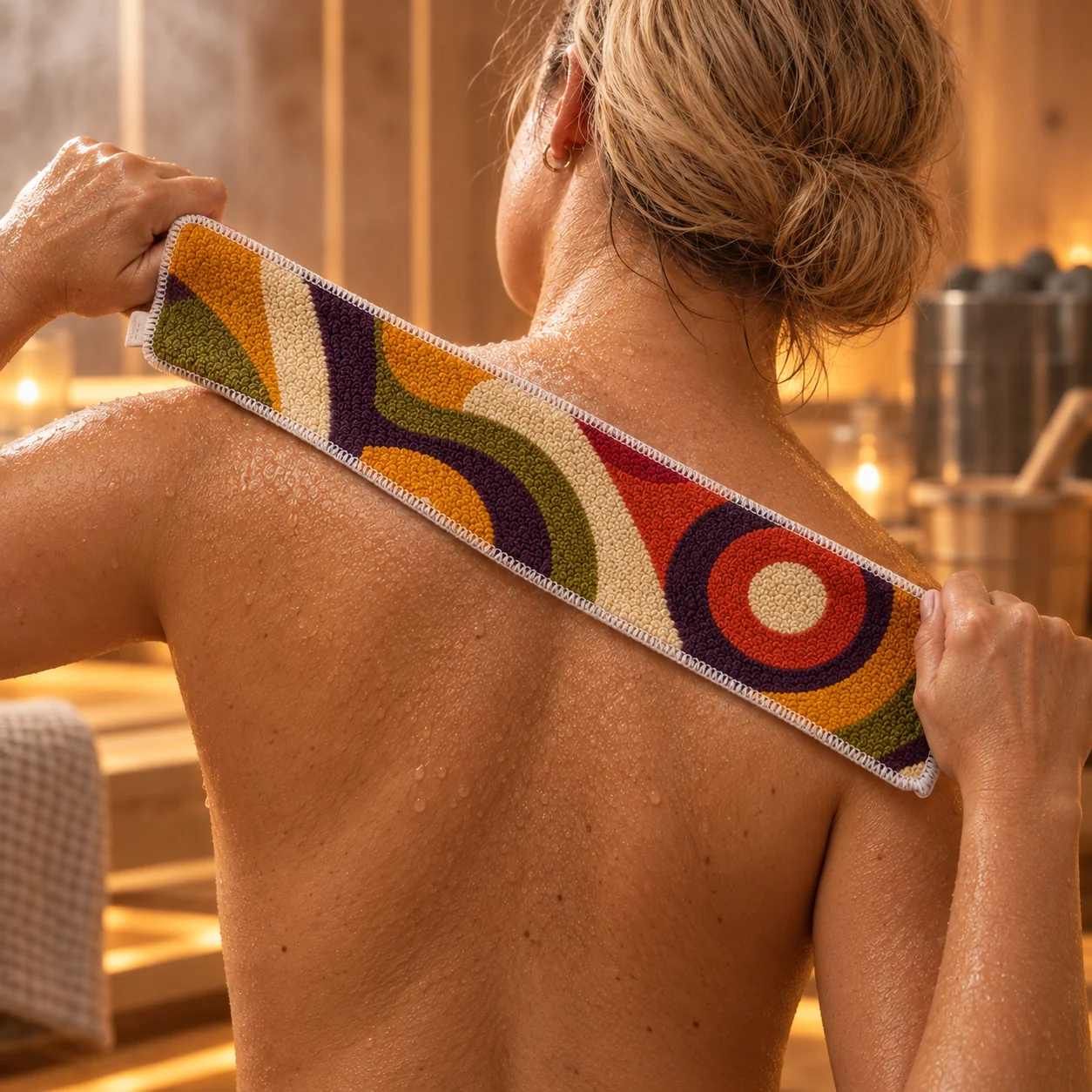
The same woven cotton structure that bites into baked grease on heavy cookware provides clean, natural dermal stimulation in the sauna. Free of synthetic chemicals, it is engineered to breathe in extreme heat, wash clean in the dishwasher at 60°C, and reset with zero lingering bacterial odors. One honest material, honoring daily rituals.
Backed by Finland’s innovation leaders.
What started as an industrial blind spot in Tampere is now scaling into a circular material platform. We are replacing single-use foams across kitchen sinks, personal wellness spaces, and commercial logistics packaging.

'/%3e%3c/svg%3e)